Thursday, November 30, 2006

Signs of Life

We just spent a week in Boston with my in-laws and I didn't have to take even one Xanax. I believe this is a sign of spiritual and cerebral health.

Other signs of health:
  • There is a reasonable amount of frozen food piled in the freezer drawer. When I have to rearrange the boxes of frozen waffles, Trader Joe's tamales and assorted Processed Organic Crap every time I open the freezer, just so I can shut it again, all is not well in the village. Likewise when the refrigerator shelves boast nothing but a few whithered carrots and a jar of mayonnaise. If there is no frozen food and the fridge is stuffed with fresh produce and meats, I'm either exceedingly energetic or about to go mad.
  • The ratio of time I spend on housewifery and on-the-clock mothering is equal to or less than the time I spend writing, doing yoga, or dancing around the attic with Harvey Danger on my iPod.
  • The strength and fortitude to "waste" baby sitter time on the above.
  • When my feisty 2-year-old starts torturing her big brother, I knock her down with tickles and start a rolicking game of chase with them both throughout the house. This happens far less often than I'd like to say. But it replaces the depressed behaviors, such as yelling and hiding in the bathroom.

Last night we got home in the middle of the night after ten hours of travel and a drive from Sea-Tac in freezing rain. Matt and I put the children to bed directly, then scarfed frozen junk food (Amy's Quiche Florentine) while standing at the kitchen island. We continued our snippy argument over who was more of a jerk in the airport.

"You know," he said, "sometimes when you get tired, you act like you're about 12 years old."

I laughed.

Health.

Sunday, November 12, 2006

Whose Hide?

Friday night, the news program 20/20 aired a segment about working mothers, and what employers and the government should be doing to help them, and, by extension, Society. The anchorwoman, Elizabeth Vargas, even went so far as to out herself as having taken maternity leave. This was her first story back. Her co-anchor marveled on-air at what full hands she had with an infant, a 3-year-old, and "this job."

I must applaud 20/20 for taking on the issue, and for suggesting that government may have a role in supporting "the family." Alas, "the family" was barely mentioned in this story. Even the co-anchor, when introducing the story and welcoming Vargas back, failed to mention whether or not he also had kids at home along with "this job," and hence, "full hands." Instead, he gave her the old, "Gosh, Hun, I just don't know how you do it."

Here's the question that wasn't asked: Where are the dads? Why didn't anyone talk about the dads? How is it that even now, when some companies offer paid paternity leave, that men are still not universally expected to share the general sacrifice that running a family requires? How can it be that in 2006, affordable childcare and flextime are still talked about as women's issues?

Raising families and running households require sacrifice. The question I constantly bat around is whose hide the sacrifice is coming out of. In an ideal family, the kids would remain in a circle of unbroken love and attention for eternity. Their little hides would never be scathed. But it's not a perfect world. We parents require rest, time off, replenishment, sleep, the occasional shower. Also most of us still need to earn a living. As parents, we are faced with constant demands for sacrifices, small and large. There are only three places where sacrifices come from in a nuclear family:

1. Mom (or Dad)
2. Dad (or the other mom)
3. The Kids

(Okay, there are also the dog, the house, the finances, friends, personal hygiene, but those are secondary and beyond the scope of this post.)

In the 20/20 scenario, it appears the sacrifices of running a family are coming out of mom and the kids. Maybe this is case for those women. I know it is true for many, many, many women. But this is just not the case all the time, in real life. So many dads step up to the job, and so many moms demand it.

So I would like to hear from you about how the dad in your family sacrifices. What comes out of his hide instead of yours or the children's? Put the story out there. The world needs to hear it.

Saturday, October 28, 2006

More Love, Please

More scribbles from the spring:

A day of rattling brains, over stimulated nerves, a queasy stomach. I’m crashing again. I seem to run in short cycles of mania and depression. Good Lord, could I be bipolar? If I am, it’s exacerbated by the citalopram. During the “manic” phase I feel boundless possibility, endless creativity, ideas popping left and right. I love everything, everyone. Yes! I say. This is life!

And then there are days like today, when I can’t handle a thing. The kids nag, I want to scream. Someone makes a demand on me, I want to knock them across the room.

In yoga class today, our sub teacher Beth focused on the yama of non-harming. Non-aggression. Which is really, says Beth, love and loving-kindness.

Love and loving-kindness were way beyond my ken today, so I meditated on non-aggression. I put my boundless aggressive energy into massive muscular dynamism. I did my standing poses like a warrior. I did my chatturanga dandasana with supple animal strength. When I was all emptied out, I did legs-up-the-wall pose and then savasana.

Savasana is always a great opportunity to feel the effects of my practice. I could see something wavering beneath all that aggression and cyclonic emotion: lack of love.

There is a lack of love in my household, I declared to myself. The kids are needy, naggy, whiny. Matt and I are depleted, irritated, always trying to get away. There is hardly ever a time when we can look at each other, face to face, and complete even a short, declarative sentence, much less a loving gaze or searching question. Trying to focus on one another feels futile. I miss him. I need us to be a real couple.

I am nervous about where my aggression lies today. It’s at my kids. I cannot connect with them. I just want them to be quiet, go away, leave me alone. I want to slough them onto someone else. I can’t do anything for them. They nag me, and pull at me, and demand of me, totally fucking constantly. Audrey has another cold, so she’s been crying and yelling a lot. Matt has a stomach aliment so he’s been running to the bathroom a lot. We are sick. This household is sick.

Lord, help us.

But what if love didn’t have to be something I made up from scratch? What if I didn’t have to create it or perform it? What if the love is always there, and now it’s buried and obscured? The love is, maybe, like the pearl. Buried under a lot of crap. But always there, always shining.

Thinking this way lets me off the hook. It relieves me of so much guilt (which I am feeling heaps of tonight). It’s not that I’m a bad person incapable of loving my children. I love them fiercely. The love is depressed by all this…depression.

Which brings me to another big question: when am I going to get better? Is this what it’s going to be like for a long time? A few good days, a few bad days, a violent haze, hello schizo mommy? Should I just put aside a trust fund for the children’s future therapy right now?

Depression is so weird because it can actually erase love. Or block my capacity to feel it, contact it, dip into its river. Oh, love, I think wearily. That’s when you don’t yell, right? I am continually stunned by the way depression can close off whole rooms in my mind, without my even noticing. It makes me feel like an utter loon.

So what do I do now? Up my dosage again?

Or this: maybe I do nothing. Maybe I just float.

Let Yourself Off the Hook Today

Still, nothing. Here's another relevant passage from my journal last spring, and something to remember as the days grow shorter:


When I was in Oakland, Jonna and I went to two yoga classes taught by her teacher, Baxter Bell. He said something so profound during a meditation. He said, “You may notice that your mind wanders off. That’s fine, you don’t need to be upset about it. Just lead it back here. No need to be mad at yourself. Just come back, over and over. Let yourself off the hook, over and over.”

I realized, that’s what I have been trying to learn over these last few months. How to let myself off the hook, over and over. It’s a practice. It’s not as if you do it one time, and now you’re ready for the world. It’s like building a muscle, or stretching a muscle. It happens over time.

Being a mother presents a unique opportunity to see oneself as a failure in all respects. After all, can you ever love your children enough? Can you ever be there for them enough? But if ever there was a job in which you need to let yourself off the hook every day, it's parenting. Otherwise, perspective is easily lost and pretty soon you're popping Xanax because the two-year-old won't eat.

Twelve-steppers know that you change your mind one day at a time. You recommit every day, you practice every day, and you only expect it of yourself today. Tomorrow is tomorrow and you can face it tomorrow. For today, do today. It’s a wonderful way to set yourself up for success. Changing behavior requires building upon small successes.

I learned that with dog-training and kid-teaching. Do it until they have a measure of success, and then stop and do it again tomorrow. It's a good tactic to use on myself.

Friday, October 27, 2006

Wuv

I am happy to report that life is good at the moment. I have child care, I have a writing project, I have health.

Thus, nothing to blog about today.

Here is a passage I wrote last winter about Jonah, age 3 at the time, during a rare period in which he wasn't sucking the life out of me:

My son and I are having a tender love affair. All day long, he smiles at me, caresses me, and complements my appearance. “I wuv that toft tweater you’re wearing,” he says often, then pets my arm or breast. “Will you pway wiv me?” he asks. “It’s nice to be together. I’m so happy to see you.”

Every afternoon we hang out on the sofa and engage in what can only be called canoodling. We snuggle, bump foreheads, give Eskimo kisses, and pat one another. Sometimes he lies on top of me and rests his head on my shoulder like he did as an infant, and other times we spoon each other and talk about things like whether bunnies are nice.

The longer this goes on, and the more Jonah keeps saying, “I like Mommy better,” to Matt, Matt is getting anxious. Today we were at the dog park, and Jonah expressed some desire to walk next to me or something, and Matt said wryly, “I think you have a new boyfriend.”

“I know,” I sighed. “But it’s perfectly natural.”

“It’s perfectly Oedipal,” he said.

I do draw the line at him caressing my breasts. “Please leave my breasts alone,” I say. “Those are private.” Of course, he’s just as happy to touch my shoulder. It seems to be all the same to him. He just wants a piece of me.

This morning he came padding into my bedroom after Audrey and Matt had gone downstairs. “Can I snuggle wiv you?” he asked. I mumbled and he crawled in bed beside me. He petted my hair, and talked to me, until finally I snapped that he could only stay if he was quiet and still. The next thing I knew, it was 20 minutes later. He’d actually let me sleep! I turned over to find him staring at me. “I was quiet,” he said. “Shall we go downstairs now?”

They say children’s personalities are basically formed by the time they’re 3. I will be happy if that’s true in his case.

Sunday, October 15, 2006

Disclaimer

Readers, I have just gone back and looked at my first month of posts and realize that it sounds as if I was beating my kids. I was not. Just so we're clear.

Tuesday, October 10, 2006

What's Your Apgar Score?

For those of you who haven't read it, The New Yorker's latest issue includes an article about the industrialization of childbirth ("The Score," by Atul Gawande). It's a refreshingly non-judgmental approach, written by a surgeon, and includes the history of obstetrics and an explanation for the prevalence of non-emergency C-section deliveries. All fascinating stuff. It doesn't judge doctors or patients, just presents the history of obstetrics-related phenomena from a surgeon's perspective.

One thing that really blew me away was learning about the birth of the Apgar score. As many of you will recall, the Apgar is the score that your baby gets at one minute and five minutes after birth, rating such things as color, breathing, crying, etc. Apparently, before there was such a thing to standardize the way doctors chose to treat (or not treat, as the case may be) infants upon their arrival in the world, the obstetrician would decide subjectively whether the baby was worth saving or not. As we now know, a baby's Apgar score can be very low at one minute and very high at five, particularly if steps have been taken to improve breathing and body temperature right away. Babies were, if I am to believe this writer, simply left to die if they were born blue, too small, or malformed. A woman named Virginia Apgar, an anasthesiologist in the 1950's, was so appalled at this practice that she devised a score for nurses to rate the condition of newborns.

The Apgar score changed everything. Suddenly all kinds of new data were being observed and collected about newborns, and now there was a way to measure - with a number - how an infant was doing at one and five minutes. It measured color (blue or pink), heart rate, vigorous breaths, and movement of all four limbs. These numbers could be compared and used as learning tools for doctors. Neonatal intensive-care units appeared. Prenatal ultrasound became common. Fetal heart monitors became standard. As Gawande, points out, hundreds of adjustments were made in the practice of obstetrics over the years since, to produce what is now called "the obstetrics package."

Ok, so the average hospital birth is full of things that most of us would rather not deal with. I don't even want to get into whether a hospital birth is bad or good, whether it's best to go with a midwife at home (back in the days when doctors didn't wash their hands between performing autopsies and examining delivering mothers, that was definitely your best option) or submit to a totally medical experience when one may not be necessary. What about what happens later?

What was your score one day after giving birth, and five days after giving birth? What about five months after? How can anyone tell? Who is to rate a mother's well-being? It seems an important part of the equation is being left out here. I believe that unless a mother is actively crying all day and night or talking about killing herself, people tend to look past us to the infant. Or just look past us.

What if there was an Apgar score for moms? What kinds of things would you want rated? What could be done to maintain your health and sanity after childbirth, and into the early years?

Wednesday, October 04, 2006

Hello, I Love You

You know how when you parent, you don't see the results for years sometimes? Or how, after you spend all that time being pregnant and then giving birth, the child doesn't even give you a smile for several months? You know how great it feels when they finally do?

Every time I read a comment from a reader, it makes my day. It makes me feel like I'm not alone, that you're not alone, that someone is reading my writing, that someone else might be thinking about some of the things contained herein. I mean, I know tons of people are wrestling with the very same questions. We just tend not to talk about it at cocktail parties. (That is, if we even get to go to cocktail parties anymore.)

So go ahead. Make my day.

That's the Real Yoga

In yoga class yesterday morning, Denise had us trying this crazy pose that almost no one could do. People were alternately laughing and complaining about it. There was a general buzz of, "Oh, yeah, right" in the room, and lots of people falling over and blowing raspberries at themselves.

Denise stopped the class.

"The reason we try these poses that seem outrageous is not just to be able to do the pose. If you can put your foot behind your head, is that really going to help you out there?" She gestured toward the windows, on the other side of which idled a noisy cement-mixing truck. "Not really," she answered for us. "But if you set your sights on the impossible, and you create the intention to go in that direction, that will help you out there. Because you're doing what hasn't been done before. That's how change happens. Now," she said. "Let's try it again on the other side."

Chastened, we all got into position. I squatted into a very low, leaning lunge. Slowly, I hooked my left shoulder under my left knee. My face came close to my left foot. (Chipping nail polish, hmm, need to take care of that.) I leaned back, tried to lift that foot off the floor and...I fell onto my butt. I got back into the pose and commanded my foot to lift. There was a slight contraction of a muscle deep in my inner thigh. Hello, little muscle, have we met? I contracted it more. My foot raised up a hair off the mat. And then I fell over again.

After class, I chatted with a woman from class as we waited for a light to change. I'll call her Diane, because I believe that's her name. She's a short, solid, middle-aged woman with steel-gray hair. She wore a button on her black sweatshirt that said, "ANOTHER QUAKER FOR PEACE."

"That was great," she said of the wacky pose. "They should put this idea in places like Yoga Journal. Doing the full pose isn't the point. When you're working hard in that direction, that's the real yoga! They need to come take pictures of our class and put that on the cover. Instead of these skinny-ninnies who can do everything."

And that, in a nutshell, is what Denise teaches us. Whatever we do, the spirit and heart of our energy is what truly matters. Setting our minds in the right place is what gets us there. It's easy to forget this sometimes watching her. She's fifty-four with a totally gorgeous bombshell body. But she does set us on the right path. Especially when it comes to our expectations about what yoga can do for us.

"I get annoyed at some claims people make for yoga," she said once. "Practicing yoga doesn't mean you never get sick or bad things never happen to you again. It gives you the skills to deal with that stuff."

So I learn, again and again, that the practice of health and balance is neverending. I will never get to the perfect life balance and then rest there. It takes intention and practice and re-evaluation.

Like now, I have regained a certain level of mental health, which has led me to be stronger and more capable, which has led me to pile more things on my calendar and desk. So I'm sort of shaking the water off my face and asking if this was the actual point of getting well. If I am to stay well, the answer is no.

So I guess I just keep moving toward what really matters and let everything else fall away. How else can I do the important work of my life?

Readers, what do you let go of when something has to give?

Sunday, October 01, 2006

Playgrounds

I'd like to take a moment to acknowledge the most depressing places on the earth: playgrounds.

I'm fine when I show up, but after ten minutes I'm in serious need of a cocktail. There is nothing with quite the stench of boredom (to borrow a phrase from my friend Jane) as a playground during the post-nap, pre-dinner time of day. Especially on a weekend. Weekdays are filled with chatty stay-at-homes, be they moms, dads, or nannies. But the weekends tend to be deadly. Especially due to the dads and their cell phones.

I can't count the number of dads I see at playgrounds yakking on their cell phones. I am sorry if I am on a man-bashing trend right now, but DAMN. Today I watched a dad talk on his phone while his three kids ran all over the playground. He talked on his phone while he led them to the SUV. And then, he talked on his phone while he loaded them into the car and safety seats with one arm. When he backed out of his parking spot, he was still talking on the phone. I see dads talking on the phone while pushing babies in bucket swings.

Is this a coping skill that I just haven't learned? Believe me, I understand the desire to run screaming from a boring hour at a playground, but I do at least mime involvement. My kids don't want to just play in the sand. They want me to play in the sand with them. Talk to them. Make eye contact. I can do this while thinking about what to write for my next blog and they probably don't have a clue.

Maybe I'm in a huff about the cell phone dads because I absolutely hate going to playgrounds in general and I think everybody else should be as miserable as I am. Truly, after being stabbed with the desire for a drink or a smoke or ANYTHING to alter my consciousness, I am beset with soul-sucking dread and dullness.

It reminds me of being nine years old on blacktop kickball court in 95 degree heat. When I was a kid, I didn't really know how to do physical play. If it didn't involve roller skating, lip-synching, or redecorating my bedroom, I'd rather be reading. So being forced to play games with balls at school was a special form of torture. On the playground at recess, I jumped rope or did cherry-drops on the bars. And then when I found my soul-mate best friend in fourth grade, we spent our recesses together cruising the blacktop and talking. That was heaven.

So maybe my current playground aversion has to do with my past, or maybe I just resent spending time doing boring shit with my kids, or maybe playgrounds are boring for everyone and no one admits it.

Anyone care to comment?

Friday, September 29, 2006

Bad Biology


To those of you with two children or even one reaching the age of two, you might identify with my current struggle:

My body is sending unmistakable signals that it's time to procreate again. There is the usual frantic urge for sex during the time that I ovulate. There are weepy, rueful feeings upon looking at my children's baby pictures. And then there are the stray thoughts, more disturbing than the physical and emotional urges, that say getting pregnant again just might be the most wonderful thing to ever happen to me.

Lord, get me to the hospital. I need shock therapy, a lobotomy, or at the very least a tubal ligation. No time to waste.

So, at dinner last night, M and I resumed our long conversation about whether or not one of us should get surgery.

"This is a big issue for me," I reiterated while picking at his crab cakes.

"It's a big issue for me, too," he reminded me.

"Yes, but I'm the one who gets pregnant. Right now you don't want surgery, but you don't want me to have surgery, so I feel rather stuck." I polished off my cocktail and ordered a glass of wine. "I am starting to like the idea of a tubal ligation."

M looked at me with exasperation and tenderness. We were both painfully aware of having had this conversation many times before, most recently quite loudly in a swanky bar where we no doubt scared the hell out of the 20-somethings at the surrounding tables.

"I just don't understand why you can't wait until I am ready," he said.

"Because, when will you be ready? In five years, when I'm forty and you're an old codger, will you finally be ready? Or will you be ready before the next time we have an accident?"

I am referring, of course, to the accidental pregnancy that resulted in our beautiful baby girl, Miss A. During the time of that accident, we were practicing the Fertility Awareness Method.

Now, I am a big fan of FAM. FAM is based on close observation of the menstrual cycle, which you carefully measure and plot on a chart. Reading the signs and the chart will tell you when you are most fertile, and when there is no chance of conception. Roughly, five days before ovulation and a few days after ovulation are times of fertility. This is good to know, especially if you are trying to concieve. But there are things to watch out for. Like, sperm can survive for up to five days before penetrating an egg. It can swim round and round in the fertile, semen-like cervical fluid that floods the female parts during this time. So if you, like me, are about to engage in unprotected sex because you have not yet seen any signs of ovulation (such as stretchy, egg-white-like fluid), consider that it just hasn't come down yet but is about to any second. Stop what you're doing and apply your least-hated form of birth control.

Or else:

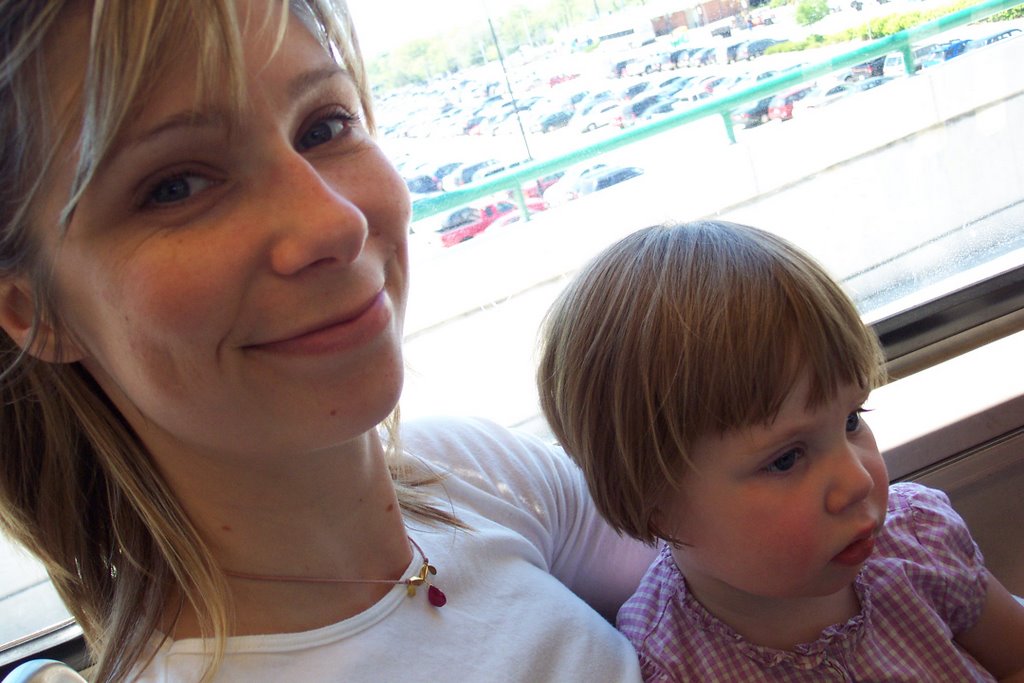
[see above adorable photo of Audrey]

Here is where the triumph of Man, our ability to override evolutionary compulsions, becomes so important. It may be true that my body wants me to make another baby. This has nothing whatever to do with whether or not I actually want to have another baby. All it has to do with is my biology. So, I must learn to ignore it. I can do that. I have learned to pass over many other urges, such as stealing drugs from medicine cabinets, inappropriate involvement with people not my husband, and eating entire cakes in one sitting.

Resisting a biological urge that comes wrapped in sentiment and mystery is not easy. If you want proof, witness how many women continue to fall in love with men who can't talk or notice when they have a feeling. The baby one in particular is tricky. It's designed to propogate the species, so it has to be at least as strong as the sex urge. Because for those of us who are married with children, the sex urge may not necessarily be able to trump the self-preservation urge that causes us to kick our husbands away in the middle of the night. So evolution has created the Misty Baby Urge.

Bah, I say. How soon can my OB/GYN be here with his scalpel?

Chocolate Shit Cookies

Bake chocolate chip cookies. Great. Hide my intellectual, professional, and artistic failings behind the fact that I can bake.

(And I really can. When I took cupcakes to my book group, several people agreed that I should start a bakery. That would be a terrible idea, but I sure appreciated their confidence.)

Not only can I bake! Ho no, my friends, I can also organize. And arrange furniture. And decorate a house in pleasing colors, textures and shapes. I can make a delicious four-course dinner for six friends. I can arrange flowers. I can cultivate plants. I can mat and frame pieces of art and hang them on the wall with decent skill. In short, I know how to do most of the nurturing, creative, comforting, beauty-making things in the large repertoire called The Domestic Arts. And that's not nothing.

But it's not everything.

To the women in my family, it is everything, or at least, the most important thing. Keeping a clean house is the best way to save face on every possible issue you can imagine, from infidelity to alcoholism. I'm serious. If a woman's house is clean, we can look past the empty bottles of vodka in the trash. "At least she's keeping it together," we will say, with a nod. Conversely, the most devoted wife and mother is only as good as her housekeeping skills. "Yes, she is sweet to her children, spoiling them a bit, I might add, but did you see her stove? Full of grease spots. That's the first thing I always look at: the stove. You can tell a lot about a person by the state of her stove." And so-called career women? The term in itself is a vulgarity. Career women are selfish. End of story. (Don't get me wrong, all the women in my family have always worked, but they have static jobs they complain about and believe everyone else should, too.)

So that's where I come from. Like my aunts, mother, cousins and grandmother, I used to hold my domestic competence in high regard. I used it as a weapon against smarty-pants boyfriends. "So what if he can quote Derrida?" I remember ranting to my writing group once about a boyfriend. "He can barely read a calendar and he doen't know how to scrub out the bathtub!" (Incidentally, the men and women of the group stared at me as if to ask what in the world was my problem.)

I believe that, as a woman, you just can't win. So why try? I'm reaching the point where I just do what feels right and don't worry about What It All Means.

Until today, of course, during this fit of insecurity. I am reading a review of Linda R. Hirschman's book, Get to Work: A Manifesto for Women of the World. Hirschman is famous for pissing people off with an article she published last year that told us we should stay in the job market for the sake of society. She says we give up too much when we agree to more than half the housework and primary care of the children. (Or, I should say, child. Those of us who pop out more than one are apparently screwing ourselves irrevocably.)

I will admit to being interested in the ideas in this book. I'd like to turn them over in my mind and see where I come out. I am very concerned about the future of equality in this nation when it comes to male-female relations and for sure when it comes to mothers' rights. At the same time, damn! I'm so weary of everyone having an opinion about what I should do with my life.

You know what Hirschman's arguments remind me of? The mud and algae covering the pearl. I made this analogy months ago during my Major Depressive Episode. For me, all the stuff covering the pearl were the stories I had told myself about who I should be, and all the stories other people had told me about who I should be. I based way too many decisions on what would be best for The World, and not what would be best for my soul. Hirschman wants to add to that? She really wants me to go out and start teaching again so I can spend the best hours of my day wrangling other people's children? (Probably not. Teaching is probably one of those wimpy helping-profession jobs that women need to start shying away from.)And, incidentally, I know a lot of women who make their decisions this way. I am not sure it is always for the best.

When are people going to start writing high-profile books about what men should be doing with their lives?

(I know, I know. Only their wives would read them. Men aren't obsessed with self-improvement like we are.)

Letting go of self-improvement was a huge step toward recovering my health this year. So was letting go of the expectations of my family, my old boyfriends (they do haunt me), radical moms, and the image of a groovy, savvy, political, artistic, devoted mother that I held up as my ideal. I flushed it all. And then I was able to do what my soul wanted.

That's pretty good women's lib. And yet, that rejection letter. I can hear the shriveled black spot in my heart saying, "Get back in the kitchen."

But you know, that rejection letter means something very important: I made contact with the world. And that is more than I could say about myself over the last five years of pregnancy, birthing and breastfeeding. So I've posted it on my wall, which I hear a lot of writers do, because it shows that I've made a step.

A batch of cookies right now would just be false comfort.

Arg

Ok, so today I got my very first rejection letter after restarting my anemic freelance career. I am happy that I got a response. I just wish it had come at 5 o'clock instead of 10 a.m. There's a lesson not to check e-mail until the end of the day...

And then, AND THEN I opened the latest Brain, Child to see that all these other women are writing about all the stuff I care about, and doing it fabulously well. My issues are all over this issue! Alcoholism, motherhood politics of working/not working, saying goodbye to sex, drugs and rock-and-roll. Nothing about depression, at least. Maternal depression beyond the scope of PPD seems not to be a hot topic. Not now. Not until I start flooding parenting and women's mags with submissions...

Oh, I am such a foolhardy human. I am one of approximately eight billion mother-writers out there with a lot of half-baked ideas and notions and a wimpy C.V. I really feel like lying down on the floor and having a good cry, but the meds make it hard for me to get to that crest of emotion. So I sit here with a pit in my belly and try to breathe.

And let's take a moment to talk about all the better blogs out there. Dooce, for example, is totally stellar. Not only is Heather Armstrong hilarious, irreverent, and a smart-ass, but she, too, is a mom on meds. She even had to be hospitalized due to severe PPD.

See, all the cool people are not just smarter, but crazier than I am.

I do hate this feeling if being an almost-funny, almost-smart, almost-talented writer. I started my life in a deficit and there I have remained. Wow, I haven't had such a crash of self-worth in a long time! So, so, so, how to survive it?

Get another submission out there.

Breathe.

Make chocolate chip cookies.

Monday, September 04, 2006

Mommy's Groove

My little girl runs to me from the kitchen crying, "Mommy I need you!" and leaps into my arms. She curls her fat arms and thighs around me and instantly becomes an extension of my body.

She weighs nearly thirty pounds now. I reach behind me and settle the two of us down on the hard wooden window seat in the dining room. I lean against the glass. I run my hand along her chubby form as it curls against my breast and belly. The sun beats onto my back through the window. It catches stands of her summer-lightened hair. I can feel her drinking me in. I sniff her head.

"Mommy," she murmurs.

Her desire nails me to the spot. Briefly, this is where I want to be. There is nothing else like this exchange of nectar between us. I clutch her and breathe. She clutches me and breathes. Who knows where this need comes from today? Is it a part of her brain developing? Is she frightened by her new muscles, her new thoughts?

It is impossible to know. But the relief, for me and for her, is that I care. For this moment, I can stop and just be what she needs me to be.

Kids will take us however we come, but it's so much better for them when we can be strong. And there.

Lauren Slater, author of Prozac Diary, writes in two of her books that kids of schizophrenic women fare better than those of depressed women. Of the schizo moms she read about in her research, she says: "They were crazy as bats, but at least they were responsive."

As I regain a certain level of health and the mental clouds clear bit by bit, I can see how unresponsive I have been. How inured to the whining and demands (3 per minute per young child, according to John Gottman) I have grown. This is depression, but also parenthood. I watch other parents do it, too, especially my husband.

For example, at the breakfast table this morning, we played our usual game of chicken as the kids whined about more cereal, more yogurt, wipe my face, yadda yadda yadda. M and I continued to rattle our newspapers and slurp coffee. Each of us pretended to be so enthralled in the newspaper articles (was it "Seattle Symphony Season Looks Ahead" or "This Year's Hottest Urban Accessory" that so captured our attention?) that we couldn't tear ourselves away. We took turns eventually giving in – he wiped J's face and then I poured more milk for A. But we can both go a long way before getting irritated enough at the noise of banging bowls and whingeing voices to get off our chairs.

This is the kind of thing that drives new and non-parents crazy. But you have to reach a level of skill when it comes to ignoring demands, or you will never eat a meal, finish a telephone conversation, or brush your teeth. And there are many demands that it's easy to ignore, because they are, as I call them, bullshit demands. "I want a fork so I can eat my milk," is such a demand.

I guess what's different now is that sometimes I have the presence of mind – and the desire – to look the child in the eyes and say, "I will help you in a minute. Right now I need to finish my bagel." In a moment of deeper generosity, I will add, "Would you like a bite while you wait?" During less lucid times (and they still occur, often), I'm more apt to fling myself around the kitchen in a fit of resentment, slamming doors and slinging cereal boxes. (Or curl my chin into my chest and start crying. The beauty part of depression is never knowing how my coping skills will fail me.) But right now, at least, I'm able to keep hold of my senses more often.

Any parent will tell you this whole routine is a self-perpetuating cycle. I find that the more responsive I am, the less demanding the children are. They don't have to yell so loud, whine so long, or make quite the spectacle that is required in more desperate times. When I can say, "Come here, my love, it looks like you need some Mommy," instead of "Get off me!" everyone is so much happier.

Thank you, Celexa, for allowing me the neurological space to relearn this behavior. May the new groove I'm wearing in the pathways go deep.

Friday, September 01, 2006

Wednesday, August 09, 2006

Fresh Hell

Things are not looking good. M and I took the kids to REI the other night, and in the car ride over I snapped. My son's incessant talking was causing my head to ring. In fact, it felt as if his whiny high voice was right intside my brain. I did yoga breaths for as long as I could and then I asked J to be quiet.

"Why?" he asked.

"Because Mommy's ears hurt."

"Why do your ears hurt?"

"Because you've been talking a lot and my ears are a little tired."

"Why does it mean that I make your ears tired?"

I let out another forceful exhalation at the corner of Broadway and John and looked to my husband for help. We were stopped at the light; I could have just stepped out. But I stayed put. After all, we needed a tent. It would be fine once we got there. The kids could loll about in tents and play with folding chairs. I just needed a moment of peace.

An hour and a half later, we were dragging J off the play structure at REI and paying for a cart load of camping crap (or Crapp, as the word is used in Neal Stephenson's The System of the World, which M is reading) while he complained bitterly about being removed from the giant plastic tree. I survived the car ride home by singing "Baa Baa Black Sheep" to the children. In the time it took M to get J out of the car, upstairs, and into pajamas, I had put the baby to bed, brushed my teeth, and crawled under my covers. M came in later and lay next to me.

"You should think about calling those psychiatrists," he said.

Made of Wax

Out of the blue, my old high school friend Brian came to visit this weekend.

After some initial awkwardness at not having seen one another for over 10 years, we slipped back into our old friendship groove. Drinking helped. We did a bar crawl on Ballard Ave. and talked about his sex life, primal therapy, fucked up relationships, and music. We skipped seeing John Wesley Harding at the Tractor Tavern because the thought of standing in a hot bar and paying attention to someone on stage didn’t appeal to us as much once we got there.

I really am drinking a lot. The weird thing is how much I can drink these days and be okay. It’s got to be the meds. So maybe I should call those shrinks.

I came across some high school diaries and started reading them. Brian is all over one of them. I said, at age 14, that he was “the kind of guy who won’t get mad if you throw up in his car.” I believe I ripped that quote off from a John Hughes movie. Anyway, he is still that kind of guy. His heart is the same.

Yesterday I started coming down from my mania. Being hung over ushered that along. Then I spoke to my mother on the phone about my cousin, L.

She told me a long, sordid tale of Laura's meth use, absent boyfriend (father of her three littlest kids), subsequent eviction, and relocation (with the three kids) to my Aunt C.'s house.

Since these events, if they are true, have been filtered through my mother, I take them with some skepticism. (Especially the details about Aunt C. finding moldy dishes, stinking piles of laundry, and empty cupboards when she came to collect L. and kids.) But the barest facts, which are that L. is alone and caring for all five of her kids all day long (her other two live with their dad near Aunt C.) with what I can assume are minimal coping skills and a little meth problem, are tragic enough.

This whole story put me under a funk that morning. I hung up the phone and continued tossing my pesto-pasta salad while making up scenes of squalor and rage with L. and her children as victims of each other. I pictured the twin 4-year-olds wandering the empty apartment while the baby stewed in a disgusting diaper. This all sent me into a bad place.

Then I packed up my salad, loaded the kids into the car and drove to my old family friend Marion’s annual Seafair party in Mt. Baker. I wanted to be chipper and upbeat, but I was stuck in my bad images. Plus, Marion's 20-year-old son, whom I have known since he was in diapers, was there with his friends and bandmates, and instead of their energy feeling fun and stimulating, it made me feel like a shriveled clod.

As I tended to my veggie burger over the broiling barbecue and the hydroplanes roared across the lake below, these thin bed-headed boys loafed on deck chairs and discussed with great autority the recent Sonic Youth show compared with other Sonic Youth shows. My silent calculation revealed that the first SY show I went to, with Bikini Kill opening, happened when these whippersnappers were in the fourth grade. Even then, at 25, I was quite late in coming to a SY conversion experience. So who the hell did these boys think they were, talking a bunch of crap like they'd been around forever? I slapped their blood-drippy cow burgers over and replaced the round Coleman barbeque lid. I felt angry for some reason I couldn't articulate.

The kids were scared of the Blue Angels screaming around the sky. I put earplugs (purchased for $1 at a Rhett Miller show in San Francisco) in J’s ears, but he still crawled all over my lap in fear. I did enjoy sitting on the sofa in Marion’s 1940-era modern house and looking at Lake Washington through a wall of glass. I fantasized about living in a house like that when M and I retire.

I general, my motivation is flagging. I am worried about getting depressed again.

Zoom, Zoom, Zoom; Bop, Bop, Bop

I’ve been in a bit of a manic phase for about two weeks. I can drink more, sleep less, and do everything that my whirling mind comes up with, to no ill effect. I still crash every day after lunch, and do need to sleep if not go catatonic in front of Blue’s Clues with my son for an hour. Also I smoke to calm down. That’s crazy, I know, but it forces me to go outside and sit still for five minutes. (This is my theory on why most people smoke.)

This state reminds me of Ayelet Waldman’s description of hypomania:

"This is hypomania: You wake up in the morning; make four lunches, preparing three individual sandwiches (one peanut butter, no jelly. One turkey with mayo, one turkey without mayo but with tomato, blotted dry so it doesn't make the bread soggy) and a thermos of soup. Each lunch gets a drink, two snacks, and a piece of fruit. You wake, dress, and feed four children, reminding everyone to take vitamins, and Omega III. You sign permission slips, and load up carpool. Then you go to the gym, do email, make plane reservations for family vacation, copy-edit essay, put finishing touches on novel, revise short story for submission to anthology, drop off meal for family with new baby at preschool, and order new bathing suits for everybody because, suddenly, despite the fact that it is February you decide that everyone needs new bathing suits and that if a single day passes without each and every member of the family having a new bathing suit the well-being of the family will collapse. Then you reorganize the kitchen hell drawer, go online and order nine superpacks of size 4 diapers (and swim diapers for the baby, too, because, after all, what's a bathing suit for a baby without a swim diaper underneath it?). Then you pick up the children from school. You never, never, do anything without talking on the phone at the same time. Most of these phone conversations should involve volunteering for things you don't actually want to do but feel you should. That is a day in the life of the average hypomanic."

So I had a few days poring over the blogs and websites of my favorite local music men, which typically I don't have or make time to do, because more important things call. I ended up posting something on Sean Nelson’s blog, about sadness being the other side of the creative coin. It's impossible for me to skip an opportunity to comment on depression.

Anyway, I wonder if I am hypomanic (which would likely mean I have bipolar II)? I kind of doubt it. I think what’s happening is a cross between the effect of Celexa being somewhat of an upper, and being totally unmoored from depression. The tethers have come loose, at least for now, and I’m flying high.

This all replaces introspection and journaling, though. It is what it is; it won’t last forever. If I ever stop journaling, someone should take note and suggest I switch meds. That would be a true personality change.

During the last depression dip, I collected several names of psychiatrists. Now that I’m better I haven’t given them a thought. I will probably wait until I feel shitty again. I have a lot going on right now.

I should probably stop drinking coffee. The thing is, I’m enjoying this. I want to squeeze every drop of productivity out of it. I mean, I’ve actually hung a few pictures on the walls around here and done a whole bunch of stuff with the kids. This is good compared to the depressive state, during which I kick aside toys, wear dirty clothes, and defrost chicken nuggets for dinner.

Another weird thing is that I’m experiencing boredom with yoga. It could be, as M. suggested, that I’m just taking too many classes.

Just checked in on Ayelet’s website, and she’s coming to Seattle in September! I’m so excited. I’m totally going to go see her, clutching my hardbound copy of Love and Other Impossible Pursuits. Now that I'm 35, there's just no reason to have shame.

Sunday, July 30, 2006

35

So. I've turned 35. 35 feels like the gateway to middle age.

I spent my actual birthday first getting up at 7 and tiptoeing out of the house for coffee at Fuel, by myself. That done, I walked to my yoga studio. I did all kinds of radiant poses and one headstand.

Later that night, M took me to see The Raconteurs. It was not the hottest night of the year (that was last Saturday when I went to see The Long Winters at an un-air-conditioned Neumo's), but you wouldn't know that because we were seated in the sweltering second tier balcony.

The Raconteurs delivered a good, old-fashioned rock show. I loved it. I just wish I could have been closer. The first thing I love about Jack White is his music, but the second thing I love about him are his teeth. Standing so near to the domed ceiling, I didn't have a chance to see his teeth. But I could still feel his madness.

Are you wondering why I'm babbling about all this stuff I don't normally babble about?

Well, I need to give it all a rest. I am not currently depressed. After the last episode, my doc upped me to 40 mgs of citalopram and that has cheered me considerably. Plus, I'm tired of writing about these matters.

This means I also have limited enthusiasm for the blog right now.

But I have lots of enthusiasm for other things. Yes, Other Things. The rest of the whole wide world. Could this be health?

I'd like to think so. But I have noticed that during these peak periods I feel like I'll never be sick again. I start making plans to get off the meds, consider cancelling therapy, etc. Inevitably, I either crash or take a nice curve back to a normal state. I'm hoping for the nice curve. The last crash wasn't so long ago.

Friday, July 28, 2006

Motherhood as a Risk Factor

This just in:

“The single highest known situational risk factor for depression is being a homemaker caring for small children, a condition that increases a woman’s vulnerability to depression by two and one-half times.”

And there’s more:

“That’s not too surprising, since caring for children is a high-stakes job with many competing and conflicting demands, little predictability, no breaks, no pay, isolation from adult company, and no genuine societal appreciation of its importance.”

That’s all I’m saying.


[Quotes from When Words Are Not Enough; The Women’s Prescription for Depression and Anxiety, by Valerie Davis Raskin, MD]