Friday, September 29, 2006

Bad Biology


To those of you with two children or even one reaching the age of two, you might identify with my current struggle:

My body is sending unmistakable signals that it's time to procreate again. There is the usual frantic urge for sex during the time that I ovulate. There are weepy, rueful feeings upon looking at my children's baby pictures. And then there are the stray thoughts, more disturbing than the physical and emotional urges, that say getting pregnant again just might be the most wonderful thing to ever happen to me.

Lord, get me to the hospital. I need shock therapy, a lobotomy, or at the very least a tubal ligation. No time to waste.

So, at dinner last night, M and I resumed our long conversation about whether or not one of us should get surgery.

"This is a big issue for me," I reiterated while picking at his crab cakes.

"It's a big issue for me, too," he reminded me.

"Yes, but I'm the one who gets pregnant. Right now you don't want surgery, but you don't want me to have surgery, so I feel rather stuck." I polished off my cocktail and ordered a glass of wine. "I am starting to like the idea of a tubal ligation."

M looked at me with exasperation and tenderness. We were both painfully aware of having had this conversation many times before, most recently quite loudly in a swanky bar where we no doubt scared the hell out of the 20-somethings at the surrounding tables.

"I just don't understand why you can't wait until I am ready," he said.

"Because, when will you be ready? In five years, when I'm forty and you're an old codger, will you finally be ready? Or will you be ready before the next time we have an accident?"

I am referring, of course, to the accidental pregnancy that resulted in our beautiful baby girl, Miss A. During the time of that accident, we were practicing the Fertility Awareness Method.

Now, I am a big fan of FAM. FAM is based on close observation of the menstrual cycle, which you carefully measure and plot on a chart. Reading the signs and the chart will tell you when you are most fertile, and when there is no chance of conception. Roughly, five days before ovulation and a few days after ovulation are times of fertility. This is good to know, especially if you are trying to concieve. But there are things to watch out for. Like, sperm can survive for up to five days before penetrating an egg. It can swim round and round in the fertile, semen-like cervical fluid that floods the female parts during this time. So if you, like me, are about to engage in unprotected sex because you have not yet seen any signs of ovulation (such as stretchy, egg-white-like fluid), consider that it just hasn't come down yet but is about to any second. Stop what you're doing and apply your least-hated form of birth control.

Or else:

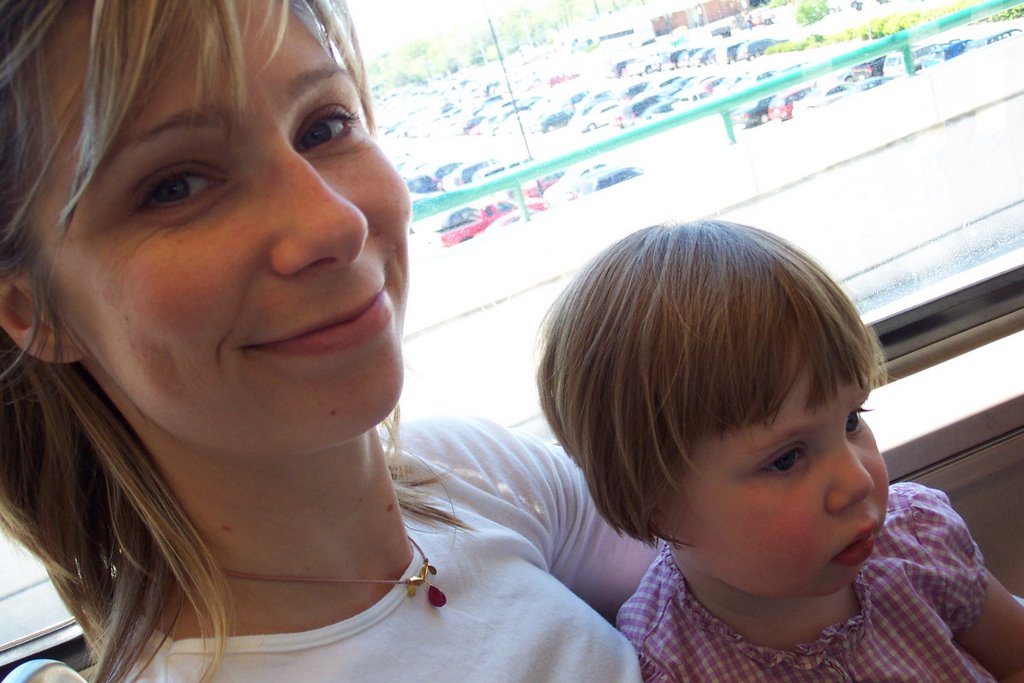
[see above adorable photo of Audrey]

Here is where the triumph of Man, our ability to override evolutionary compulsions, becomes so important. It may be true that my body wants me to make another baby. This has nothing whatever to do with whether or not I actually want to have another baby. All it has to do with is my biology. So, I must learn to ignore it. I can do that. I have learned to pass over many other urges, such as stealing drugs from medicine cabinets, inappropriate involvement with people not my husband, and eating entire cakes in one sitting.

Resisting a biological urge that comes wrapped in sentiment and mystery is not easy. If you want proof, witness how many women continue to fall in love with men who can't talk or notice when they have a feeling. The baby one in particular is tricky. It's designed to propogate the species, so it has to be at least as strong as the sex urge. Because for those of us who are married with children, the sex urge may not necessarily be able to trump the self-preservation urge that causes us to kick our husbands away in the middle of the night. So evolution has created the Misty Baby Urge.

Bah, I say. How soon can my OB/GYN be here with his scalpel?

Chocolate Shit Cookies

Bake chocolate chip cookies. Great. Hide my intellectual, professional, and artistic failings behind the fact that I can bake.

(And I really can. When I took cupcakes to my book group, several people agreed that I should start a bakery. That would be a terrible idea, but I sure appreciated their confidence.)

Not only can I bake! Ho no, my friends, I can also organize. And arrange furniture. And decorate a house in pleasing colors, textures and shapes. I can make a delicious four-course dinner for six friends. I can arrange flowers. I can cultivate plants. I can mat and frame pieces of art and hang them on the wall with decent skill. In short, I know how to do most of the nurturing, creative, comforting, beauty-making things in the large repertoire called The Domestic Arts. And that's not nothing.

But it's not everything.

To the women in my family, it is everything, or at least, the most important thing. Keeping a clean house is the best way to save face on every possible issue you can imagine, from infidelity to alcoholism. I'm serious. If a woman's house is clean, we can look past the empty bottles of vodka in the trash. "At least she's keeping it together," we will say, with a nod. Conversely, the most devoted wife and mother is only as good as her housekeeping skills. "Yes, she is sweet to her children, spoiling them a bit, I might add, but did you see her stove? Full of grease spots. That's the first thing I always look at: the stove. You can tell a lot about a person by the state of her stove." And so-called career women? The term in itself is a vulgarity. Career women are selfish. End of story. (Don't get me wrong, all the women in my family have always worked, but they have static jobs they complain about and believe everyone else should, too.)

So that's where I come from. Like my aunts, mother, cousins and grandmother, I used to hold my domestic competence in high regard. I used it as a weapon against smarty-pants boyfriends. "So what if he can quote Derrida?" I remember ranting to my writing group once about a boyfriend. "He can barely read a calendar and he doen't know how to scrub out the bathtub!" (Incidentally, the men and women of the group stared at me as if to ask what in the world was my problem.)

I believe that, as a woman, you just can't win. So why try? I'm reaching the point where I just do what feels right and don't worry about What It All Means.

Until today, of course, during this fit of insecurity. I am reading a review of Linda R. Hirschman's book, Get to Work: A Manifesto for Women of the World. Hirschman is famous for pissing people off with an article she published last year that told us we should stay in the job market for the sake of society. She says we give up too much when we agree to more than half the housework and primary care of the children. (Or, I should say, child. Those of us who pop out more than one are apparently screwing ourselves irrevocably.)

I will admit to being interested in the ideas in this book. I'd like to turn them over in my mind and see where I come out. I am very concerned about the future of equality in this nation when it comes to male-female relations and for sure when it comes to mothers' rights. At the same time, damn! I'm so weary of everyone having an opinion about what I should do with my life.

You know what Hirschman's arguments remind me of? The mud and algae covering the pearl. I made this analogy months ago during my Major Depressive Episode. For me, all the stuff covering the pearl were the stories I had told myself about who I should be, and all the stories other people had told me about who I should be. I based way too many decisions on what would be best for The World, and not what would be best for my soul. Hirschman wants to add to that? She really wants me to go out and start teaching again so I can spend the best hours of my day wrangling other people's children? (Probably not. Teaching is probably one of those wimpy helping-profession jobs that women need to start shying away from.)And, incidentally, I know a lot of women who make their decisions this way. I am not sure it is always for the best.

When are people going to start writing high-profile books about what men should be doing with their lives?

(I know, I know. Only their wives would read them. Men aren't obsessed with self-improvement like we are.)

Letting go of self-improvement was a huge step toward recovering my health this year. So was letting go of the expectations of my family, my old boyfriends (they do haunt me), radical moms, and the image of a groovy, savvy, political, artistic, devoted mother that I held up as my ideal. I flushed it all. And then I was able to do what my soul wanted.

That's pretty good women's lib. And yet, that rejection letter. I can hear the shriveled black spot in my heart saying, "Get back in the kitchen."

But you know, that rejection letter means something very important: I made contact with the world. And that is more than I could say about myself over the last five years of pregnancy, birthing and breastfeeding. So I've posted it on my wall, which I hear a lot of writers do, because it shows that I've made a step.

A batch of cookies right now would just be false comfort.

Arg

Ok, so today I got my very first rejection letter after restarting my anemic freelance career. I am happy that I got a response. I just wish it had come at 5 o'clock instead of 10 a.m. There's a lesson not to check e-mail until the end of the day...

And then, AND THEN I opened the latest Brain, Child to see that all these other women are writing about all the stuff I care about, and doing it fabulously well. My issues are all over this issue! Alcoholism, motherhood politics of working/not working, saying goodbye to sex, drugs and rock-and-roll. Nothing about depression, at least. Maternal depression beyond the scope of PPD seems not to be a hot topic. Not now. Not until I start flooding parenting and women's mags with submissions...

Oh, I am such a foolhardy human. I am one of approximately eight billion mother-writers out there with a lot of half-baked ideas and notions and a wimpy C.V. I really feel like lying down on the floor and having a good cry, but the meds make it hard for me to get to that crest of emotion. So I sit here with a pit in my belly and try to breathe.

And let's take a moment to talk about all the better blogs out there. Dooce, for example, is totally stellar. Not only is Heather Armstrong hilarious, irreverent, and a smart-ass, but she, too, is a mom on meds. She even had to be hospitalized due to severe PPD.

See, all the cool people are not just smarter, but crazier than I am.

I do hate this feeling if being an almost-funny, almost-smart, almost-talented writer. I started my life in a deficit and there I have remained. Wow, I haven't had such a crash of self-worth in a long time! So, so, so, how to survive it?

Get another submission out there.

Breathe.

Make chocolate chip cookies.

Monday, September 04, 2006

Mommy's Groove

My little girl runs to me from the kitchen crying, "Mommy I need you!" and leaps into my arms. She curls her fat arms and thighs around me and instantly becomes an extension of my body.

She weighs nearly thirty pounds now. I reach behind me and settle the two of us down on the hard wooden window seat in the dining room. I lean against the glass. I run my hand along her chubby form as it curls against my breast and belly. The sun beats onto my back through the window. It catches stands of her summer-lightened hair. I can feel her drinking me in. I sniff her head.

"Mommy," she murmurs.

Her desire nails me to the spot. Briefly, this is where I want to be. There is nothing else like this exchange of nectar between us. I clutch her and breathe. She clutches me and breathes. Who knows where this need comes from today? Is it a part of her brain developing? Is she frightened by her new muscles, her new thoughts?

It is impossible to know. But the relief, for me and for her, is that I care. For this moment, I can stop and just be what she needs me to be.

Kids will take us however we come, but it's so much better for them when we can be strong. And there.

Lauren Slater, author of Prozac Diary, writes in two of her books that kids of schizophrenic women fare better than those of depressed women. Of the schizo moms she read about in her research, she says: "They were crazy as bats, but at least they were responsive."

As I regain a certain level of health and the mental clouds clear bit by bit, I can see how unresponsive I have been. How inured to the whining and demands (3 per minute per young child, according to John Gottman) I have grown. This is depression, but also parenthood. I watch other parents do it, too, especially my husband.

For example, at the breakfast table this morning, we played our usual game of chicken as the kids whined about more cereal, more yogurt, wipe my face, yadda yadda yadda. M and I continued to rattle our newspapers and slurp coffee. Each of us pretended to be so enthralled in the newspaper articles (was it "Seattle Symphony Season Looks Ahead" or "This Year's Hottest Urban Accessory" that so captured our attention?) that we couldn't tear ourselves away. We took turns eventually giving in – he wiped J's face and then I poured more milk for A. But we can both go a long way before getting irritated enough at the noise of banging bowls and whingeing voices to get off our chairs.

This is the kind of thing that drives new and non-parents crazy. But you have to reach a level of skill when it comes to ignoring demands, or you will never eat a meal, finish a telephone conversation, or brush your teeth. And there are many demands that it's easy to ignore, because they are, as I call them, bullshit demands. "I want a fork so I can eat my milk," is such a demand.

I guess what's different now is that sometimes I have the presence of mind – and the desire – to look the child in the eyes and say, "I will help you in a minute. Right now I need to finish my bagel." In a moment of deeper generosity, I will add, "Would you like a bite while you wait?" During less lucid times (and they still occur, often), I'm more apt to fling myself around the kitchen in a fit of resentment, slamming doors and slinging cereal boxes. (Or curl my chin into my chest and start crying. The beauty part of depression is never knowing how my coping skills will fail me.) But right now, at least, I'm able to keep hold of my senses more often.

Any parent will tell you this whole routine is a self-perpetuating cycle. I find that the more responsive I am, the less demanding the children are. They don't have to yell so loud, whine so long, or make quite the spectacle that is required in more desperate times. When I can say, "Come here, my love, it looks like you need some Mommy," instead of "Get off me!" everyone is so much happier.

Thank you, Celexa, for allowing me the neurological space to relearn this behavior. May the new groove I'm wearing in the pathways go deep.

Friday, September 01, 2006

Wednesday, August 09, 2006

Fresh Hell

Things are not looking good. M and I took the kids to REI the other night, and in the car ride over I snapped. My son's incessant talking was causing my head to ring. In fact, it felt as if his whiny high voice was right intside my brain. I did yoga breaths for as long as I could and then I asked J to be quiet.

"Why?" he asked.

"Because Mommy's ears hurt."

"Why do your ears hurt?"

"Because you've been talking a lot and my ears are a little tired."

"Why does it mean that I make your ears tired?"

I let out another forceful exhalation at the corner of Broadway and John and looked to my husband for help. We were stopped at the light; I could have just stepped out. But I stayed put. After all, we needed a tent. It would be fine once we got there. The kids could loll about in tents and play with folding chairs. I just needed a moment of peace.

An hour and a half later, we were dragging J off the play structure at REI and paying for a cart load of camping crap (or Crapp, as the word is used in Neal Stephenson's The System of the World, which M is reading) while he complained bitterly about being removed from the giant plastic tree. I survived the car ride home by singing "Baa Baa Black Sheep" to the children. In the time it took M to get J out of the car, upstairs, and into pajamas, I had put the baby to bed, brushed my teeth, and crawled under my covers. M came in later and lay next to me.

"You should think about calling those psychiatrists," he said.

Made of Wax

Out of the blue, my old high school friend Brian came to visit this weekend.

After some initial awkwardness at not having seen one another for over 10 years, we slipped back into our old friendship groove. Drinking helped. We did a bar crawl on Ballard Ave. and talked about his sex life, primal therapy, fucked up relationships, and music. We skipped seeing John Wesley Harding at the Tractor Tavern because the thought of standing in a hot bar and paying attention to someone on stage didn’t appeal to us as much once we got there.

I really am drinking a lot. The weird thing is how much I can drink these days and be okay. It’s got to be the meds. So maybe I should call those shrinks.

I came across some high school diaries and started reading them. Brian is all over one of them. I said, at age 14, that he was “the kind of guy who won’t get mad if you throw up in his car.” I believe I ripped that quote off from a John Hughes movie. Anyway, he is still that kind of guy. His heart is the same.

Yesterday I started coming down from my mania. Being hung over ushered that along. Then I spoke to my mother on the phone about my cousin, L.

She told me a long, sordid tale of Laura's meth use, absent boyfriend (father of her three littlest kids), subsequent eviction, and relocation (with the three kids) to my Aunt C.'s house.

Since these events, if they are true, have been filtered through my mother, I take them with some skepticism. (Especially the details about Aunt C. finding moldy dishes, stinking piles of laundry, and empty cupboards when she came to collect L. and kids.) But the barest facts, which are that L. is alone and caring for all five of her kids all day long (her other two live with their dad near Aunt C.) with what I can assume are minimal coping skills and a little meth problem, are tragic enough.

This whole story put me under a funk that morning. I hung up the phone and continued tossing my pesto-pasta salad while making up scenes of squalor and rage with L. and her children as victims of each other. I pictured the twin 4-year-olds wandering the empty apartment while the baby stewed in a disgusting diaper. This all sent me into a bad place.

Then I packed up my salad, loaded the kids into the car and drove to my old family friend Marion’s annual Seafair party in Mt. Baker. I wanted to be chipper and upbeat, but I was stuck in my bad images. Plus, Marion's 20-year-old son, whom I have known since he was in diapers, was there with his friends and bandmates, and instead of their energy feeling fun and stimulating, it made me feel like a shriveled clod.

As I tended to my veggie burger over the broiling barbecue and the hydroplanes roared across the lake below, these thin bed-headed boys loafed on deck chairs and discussed with great autority the recent Sonic Youth show compared with other Sonic Youth shows. My silent calculation revealed that the first SY show I went to, with Bikini Kill opening, happened when these whippersnappers were in the fourth grade. Even then, at 25, I was quite late in coming to a SY conversion experience. So who the hell did these boys think they were, talking a bunch of crap like they'd been around forever? I slapped their blood-drippy cow burgers over and replaced the round Coleman barbeque lid. I felt angry for some reason I couldn't articulate.

The kids were scared of the Blue Angels screaming around the sky. I put earplugs (purchased for $1 at a Rhett Miller show in San Francisco) in J’s ears, but he still crawled all over my lap in fear. I did enjoy sitting on the sofa in Marion’s 1940-era modern house and looking at Lake Washington through a wall of glass. I fantasized about living in a house like that when M and I retire.

I general, my motivation is flagging. I am worried about getting depressed again.

Zoom, Zoom, Zoom; Bop, Bop, Bop

I’ve been in a bit of a manic phase for about two weeks. I can drink more, sleep less, and do everything that my whirling mind comes up with, to no ill effect. I still crash every day after lunch, and do need to sleep if not go catatonic in front of Blue’s Clues with my son for an hour. Also I smoke to calm down. That’s crazy, I know, but it forces me to go outside and sit still for five minutes. (This is my theory on why most people smoke.)

This state reminds me of Ayelet Waldman’s description of hypomania:

"This is hypomania: You wake up in the morning; make four lunches, preparing three individual sandwiches (one peanut butter, no jelly. One turkey with mayo, one turkey without mayo but with tomato, blotted dry so it doesn't make the bread soggy) and a thermos of soup. Each lunch gets a drink, two snacks, and a piece of fruit. You wake, dress, and feed four children, reminding everyone to take vitamins, and Omega III. You sign permission slips, and load up carpool. Then you go to the gym, do email, make plane reservations for family vacation, copy-edit essay, put finishing touches on novel, revise short story for submission to anthology, drop off meal for family with new baby at preschool, and order new bathing suits for everybody because, suddenly, despite the fact that it is February you decide that everyone needs new bathing suits and that if a single day passes without each and every member of the family having a new bathing suit the well-being of the family will collapse. Then you reorganize the kitchen hell drawer, go online and order nine superpacks of size 4 diapers (and swim diapers for the baby, too, because, after all, what's a bathing suit for a baby without a swim diaper underneath it?). Then you pick up the children from school. You never, never, do anything without talking on the phone at the same time. Most of these phone conversations should involve volunteering for things you don't actually want to do but feel you should. That is a day in the life of the average hypomanic."

So I had a few days poring over the blogs and websites of my favorite local music men, which typically I don't have or make time to do, because more important things call. I ended up posting something on Sean Nelson’s blog, about sadness being the other side of the creative coin. It's impossible for me to skip an opportunity to comment on depression.

Anyway, I wonder if I am hypomanic (which would likely mean I have bipolar II)? I kind of doubt it. I think what’s happening is a cross between the effect of Celexa being somewhat of an upper, and being totally unmoored from depression. The tethers have come loose, at least for now, and I’m flying high.

This all replaces introspection and journaling, though. It is what it is; it won’t last forever. If I ever stop journaling, someone should take note and suggest I switch meds. That would be a true personality change.

During the last depression dip, I collected several names of psychiatrists. Now that I’m better I haven’t given them a thought. I will probably wait until I feel shitty again. I have a lot going on right now.

I should probably stop drinking coffee. The thing is, I’m enjoying this. I want to squeeze every drop of productivity out of it. I mean, I’ve actually hung a few pictures on the walls around here and done a whole bunch of stuff with the kids. This is good compared to the depressive state, during which I kick aside toys, wear dirty clothes, and defrost chicken nuggets for dinner.

Another weird thing is that I’m experiencing boredom with yoga. It could be, as M. suggested, that I’m just taking too many classes.

Just checked in on Ayelet’s website, and she’s coming to Seattle in September! I’m so excited. I’m totally going to go see her, clutching my hardbound copy of Love and Other Impossible Pursuits. Now that I'm 35, there's just no reason to have shame.

Sunday, July 30, 2006

35

So. I've turned 35. 35 feels like the gateway to middle age.

I spent my actual birthday first getting up at 7 and tiptoeing out of the house for coffee at Fuel, by myself. That done, I walked to my yoga studio. I did all kinds of radiant poses and one headstand.

Later that night, M took me to see The Raconteurs. It was not the hottest night of the year (that was last Saturday when I went to see The Long Winters at an un-air-conditioned Neumo's), but you wouldn't know that because we were seated in the sweltering second tier balcony.

The Raconteurs delivered a good, old-fashioned rock show. I loved it. I just wish I could have been closer. The first thing I love about Jack White is his music, but the second thing I love about him are his teeth. Standing so near to the domed ceiling, I didn't have a chance to see his teeth. But I could still feel his madness.

Are you wondering why I'm babbling about all this stuff I don't normally babble about?

Well, I need to give it all a rest. I am not currently depressed. After the last episode, my doc upped me to 40 mgs of citalopram and that has cheered me considerably. Plus, I'm tired of writing about these matters.

This means I also have limited enthusiasm for the blog right now.

But I have lots of enthusiasm for other things. Yes, Other Things. The rest of the whole wide world. Could this be health?

I'd like to think so. But I have noticed that during these peak periods I feel like I'll never be sick again. I start making plans to get off the meds, consider cancelling therapy, etc. Inevitably, I either crash or take a nice curve back to a normal state. I'm hoping for the nice curve. The last crash wasn't so long ago.

Friday, July 28, 2006

Motherhood as a Risk Factor

This just in:

“The single highest known situational risk factor for depression is being a homemaker caring for small children, a condition that increases a woman’s vulnerability to depression by two and one-half times.”

And there’s more:

“That’s not too surprising, since caring for children is a high-stakes job with many competing and conflicting demands, little predictability, no breaks, no pay, isolation from adult company, and no genuine societal appreciation of its importance.”

That’s all I’m saying.


[Quotes from When Words Are Not Enough; The Women’s Prescription for Depression and Anxiety, by Valerie Davis Raskin, MD]

Tuesday, July 11, 2006

A Little Bit Spiritual

“I am becoming a little bit spiritual, which I’m sure is not a side effect Eli Lilly reports in its literature on Prozac.”
From Prozac Diary by Lauren Slater

I read this line and smile to myself. I remember when I started taking Paxil in January, I noticed a calming effect and a new ability to float. It was Zen, the way I could just notice something lovely like, say a robin hopping on the lawn, and think, “How lovely.” Gone were the cobwebs in front of my eyes, gone was the heart-pounding feeling that I should be noticing this more, feeling it more. A bird! I should be exclaiming to myself, like Walt Whitman. Is there nothing more perfect than this bird, this moment? On Paxil, I didn’t have to dredge up the appreciation. It was there, and then, like the bird, gone. There was no problem.
This is the relief I feel when the medicine is working. The pain is gone. I am almost a normal functioning person. At least normal enough, for me, to do my life. I can do all that I really need to do. I can write, and take care of my children, and have a relationship with my husband, and see friends, and read, be interested in the world, and keep the minimum requirements as mistress of this house.
My illness placed a scrim over my vision, and a levee around my heart. What I can feel, now drugged on appropriate levels of serotonin, are things like synchronicity. Fleeting beauty. Direct connection between the sun and my soul, my child’s eyes and my heart. Zap. Zing. Ah. It’s not operatic ecstasy, it’s life as good as anyone could want it.
In Prozac Diary, Lauren Slater finds she can enjoy sipping a latte for the first time in her 26 years. Rocking in a rocking chair, just for its own sake, is pleasurable. A former anorexic, depressive, and sufferer of OCD, she grows very suspicious of this ability she suddenly has to contact the beauty of daily life. She asks:

“What does it mean, for instance, that my burgeoning contemplative bent does not come directly from God but from Prozac? Might this mean that Prozac is equal to God? What an awful, awful thought. So turn it around. Primitive cultures often use drugs as a means of accessing their gods. That’s better. Maybe Prozac is to the modern world what peyote is the to Indians.”

As I feel myself as more healthy, I can feel other things, too. It’s as if I have gotten out of my own way, and oh, what a beautiful morning! If this isn’t “real,” I don’t care.
But it is real. I’ve been here before.

Monday, June 26, 2006

Time Out

My best friend sent me a Zen parenting book. It’s called “Time-Out for Parents.” What I’ve gleaned so far is the notion that we parents are doing no service to anyone by ignoring our own needs and emotions.

We all know that. But making a change is really hard when you don’t know exactly what it means to pay attention to your own needs and emotions. When you are so used to being pissed off, there’s no warning flag. Nothing actually feels amiss. “Yeah, poisonous anger! Here it is again! What else is new!”

As I’ve regained some level of health and functionality, it is easier to fall into the old habit of ignoring those moments. They come back in the old way, these subtle feelings of anger and frustration that seep in practically unnoticed. I wonder if they come so sneakily because I am so used to swatting them away or ignoring them for more “important” issues, like finishing the laundry or completing an endless game of Candy Land with my son. Then later, something sets me off and lo, I’m already at my limit. How did that happen?

Here's an example. This spring, my family and I were having a nice, peaceful Saturday, when my son suddenly fell into a massive temper tantrum. This was the screaming, crying, limb-flinging kind of storm that nothing can abate. It just has to pass.

At first, I stayed present with him and observed his outburst with a barely restrained desire to smack him silly and toss him in his room. That’s what my grandmother and mother did. (But that’s not the kind of mother I want to be.) With M’s help, we got him redirected and calmed down. It took a lot out of us.

I didn’t realize how much, until J and I were playing with his train set and suddenly I realized it was approaching the deciding moment for dinner: are we cooking, getting take out, scrounging, or going out?

Suddenly I was fully irritated at my husband. He never seemed to notice when it was time to make these decisions. He didn’t get how long it took to cook, to shop, to plan, how much it took out of me to always be the one in charge of this, how much I really resented it some days.

“So what are we doing for dinner?” I snapped, trying to shift responsibility. (FYI, this tactic never, ever works.)

“I don’t know, I can go to the store and get stuff to cook if you want.”

If I want!

“There isn’t time for that,” I said. “I don’t have time to go looking through cookbooks and make a shopping list and cook all before the kids are ready to eat.”

“Well, can we just scrounge on what’s here?”

“Such as what?” I demanded.

“I don’t know, can we just make sandwiches or something?”

I thought for a moment. Part of my troubles before had been that it was hard for me to present too many makeshift meals per week to my family. M had been trying to convince me for years that he truly did not care. I had been making it my new practice to stop caring, too. And to accept M’s suggestions, no matter what. We had too long a history of me demanding that he take responsibility for a decision and then rejecting it. So, I said, “Fine. We’ll have sandwiches.”

I turned back to the train set. I was still feeling huffy. J insisted on trying to link up two ends of a circle that just weren’t going to meet. Then he got frustrated and started trying to force them.

“Stop it!" I admonished. "If you have to force it, it isn’t going to work!”

Some wrangling ensued. I realized I was all of a sudden engaged in “duty play.” Duty play is “playing” with my son and hating every minute of it. M had observed this in the past and told me that when I’m doing that, I’m not being nice to J, and no one is having any fun. So I stopped and sat back on my heels. M was still sort of hanging around the scene and he looked at me.

“Susie, do you need to…”

“…take a time out?” I laughed. He laughed nervously back.

“Well, yeah.”

“Yes,” I said. I stood up. “See you in a half hour.”

I had resisted leaving the scene for many reasons. First, guilt over not having played with J earlier when he needed it, thus setting the stage for a tantrum. Second, relief at having gotten him calmed down and fear that he wouldn’t stay that way. Third, duty to M, who said he really wanted some kid-free time to work on our taxes. So we had guilt, fear, and duty. No wonder I was in a foul mood.

In my white bedroom, with the door closed and afternoon sunlight streaming in the windows, I opened the Zen parenting book and flipped to a page that said,

Stop! Take time out to be present to yourself, to your breath, to your feelings, to your experience of the moment.

What a fucking concept, I thought. How is this even possible right now?

Take a few slow, deep breaths, and notice what it’s like to be present to the thoughts, emotions, and sensations you are experiencing.
Ask yourself, What am I feeling?

I’m annoyed at my husband over the dinner thing. I’m annoyed at my son for causing such a scene and throwing me out of balance. I am scheming about how the rest of the day will happen, should happen. I’m out of balance. And annoyed.

Simply be present in this moment, just noticing.

I noticed, and then I closed the book and stopped “working.” I was literally sitting on my bed with a notebook and a pen in hand, ready to “work” through this problem.

But there was no problem. I was just having some feelings.

I watched them dissipate.

I set aside the book, the notebook, and the pen. I lay down under my down comforter in what I jokingly call “reclined meditation pose.” I observed myself settle into a quiet state between meditation and dozing. I still had twenty whole minutes to stay like this.

Afterwards, I went downstairs, hugged my husband and had a good chuckle with him. Then I opened the refrigerator and mentally threw together a bunch of ingredients I’d forgotten were there.

There was no problem.

Floating on the Path

I keep asking myself when I am going to get better.

Then I find if I shift my question from a medical perspective (“When is this medicine going to fix my problem?”), and look at it from the perspective of a person on her path, the question melts away.

Then, my benevolent witness arises. She notices that all this time, I have continued to be on the path, whether I realized it or not. And she reminds me gently that, no matter how long I continue to look for relief in the external world, I will continue to be myself, and I will continue to be on my path.

This is a thorny and complicated idea for a person with mental illness. It’s a thorny and complicated idea for many of us with a long history of either/or thinking. It involves the idea of acceptance, which is nearly impossible for so many of us. It involves the practice of floating, which is a skill almost no one possesses.

Denise says, make the effort, and then surf. Ride it.

This is essentially what I am doing. I make my effort: in yoga, in therapy, in taking care of myself in the ways that I know I need. And then I ride the effect. It is not just my own effort that I am riding. It’s the Great Energy, the Life Force that I’m riding. Surfing it, riding it, allowing it to work, is the only way to “get better.” It involves surfing out into the great unknown, having no ground beneath my feet, and being open to the possibility of what I find.

This is preferable to my own methods of “fixing” myself, which tend to be quite small-minded. If I make a game plan, I have expectations of what should happen along the way. There’s just no getting around that; it’s what our minds do. We look for results, the grade, a chance to critique our progress so we can decide if we are the most excellent student of [blank] in the universe, or the most pathetic [blank] in the universe. (This whole procedure amuses me when I think of what it really is: flipping the coin of judgment to grasp either grandiosity or self-degradation.)

My goal after my breakdown was to cease self-improvement. This may sound counter-intuitive: If I was broken, didn’t I want to be put back together?

I did not, and I do not. I do not want to be put back together in the same way. I have lived most of my life in repetitive cycles of the same kinds of conflict, of endless boxing rounds with the same opponents. If there was some way to make myself better using my known methods, I would have done it already. But the truth is, nothing has “worked.” So, facing no other choice, I let go of almost everything.

Now, I make my small efforts at health (yoga, therapy, medication, attention to my needs) and float.

Saturday, June 10, 2006

For Real

I am a total nightmare. Every time I'm doing okay, I think that's how it's always going to be , and then, woops! Guess what? I think, Hmm, I have about ten Xanax left, and a whole untouched bottle of Paxil; if I chased them with a bottle of Maker's Mark, I bet that would be pretty nice.

Pretty nice?! I was just having a day, you know, driving the kids and the dog to Magnussen Park. Then along comes this Okkervil River song on KEXP. Talking about how some nights he has the thirst for real blood. Talking about how he's obsessed with all this edge-of-suicide stuff. And I'm driving over the grating of the Montlake Bridge, and the sun is glinting in through the sunroof of my station wagon, and I'm thinking, "Mmmm, yeah, that does sound good."

That's what a good song does, though. You can feel all this crazy stuff in the space of two and half minutes and you can just let it wash through you and go on with your day.

Unless you are a depressive. Then the feeling stays with you. Then the feeling gathers strength, beomes distorted, scrambles your perpective, and sometimes, completely fucks you up. You're predisposed.

So what did I do? I didn't drive into the Montlake Cut. I drove to the park. I threw the tennis ball to the dog. I took the kids to the playground. I slid down the tandem slides with Miss A. And then, as the kids diddled around in the sandbox, I wrote in my notebook about how I'd do it. And then the next day I told my shrink.

Truth be told, I was already thinking about it the day before. Considering if I really wanted to die, or if I just wanted to make everyone think I wanted to die, so I could get lots of attention and care. How could I have these fucked up compulsions and just keep living daily life? Is this my illness or is this just bratty existential ennui?

Either way, the only thing for me is to keep on keepin’ on. In AA parlance, I say to myself that just for today I won’t kill myself. Or, as I read in last week’s New York Times Magazine back page story, “Oh, what the hell. I could always kill myself tomorrow.”

But I won't, of course, because I have children. In a terrible movie called “The Anniversary Party,” a high-on-X mother played by Phoebe Cates says to Jennifer Jason Leigh (with some consternation), “Once you have children, you can’t commit suicide. They completely rob you of that option.” I think about that, think about J and A at six, ten, fourteen, with no mother, knowing at some point that their mom offed herself. Of course they would blame themselves, that’s what children do. And kids don’t get over that kind of thing. I mean, how could they not go through their adult lives waiting for the other shoe to drop? Terrible. I won’t do that to them.

So I have to stay alive for them. Can I be more than a ghost? I don’t want to be a ghost. I don’t want to be a checked out parent. But I think of the long life ahead of us, the years and years of having to be there, giving them my love and attention. Protecting them. Going to bat for them. Making sure they are getting their needs met at school, in their social lives. Gotta be there for that. Gotta do that for them. Why have kids at all if you’re not going to do all of that?

There’s no escape hatch. That’s the tiring part. Maybe it wouldn't feel so tiring if I wasn't dealing with depression. Or maybe it wouldn't feel so tiring if my ultimate goal in life was something other than reading and being left alone as much as possible. So here we are.

When I'm quiet, my benevolent witness arises. Today s/he's in the form of a jovial Buddhist monk. Oh, yes, suicidal thoughts again, he says, smiling. Breathe in, breathe out.

p.s. My shrink was unconcerned. "We all fantasize about suicide at some point," she said. I must not seem like a high risk.

Sunday, June 04, 2006

Tell Yourself a Story

My yoga teacher, Denise, one day casually named the crazy mental leaps we make all the time: it’s called making up stories. We do it instinctively. Whatever is happening, we create a storyline about what it is, who caused it, why they did it, and what is going to happen next. Usually we pay more attention to the story than to what is actually happening.

Through repeated conjuring, these stories gain a lot of power. I’ve made up so many stories about myself over the years that I’ve gotten to points where I was sure I couldn’t do anything. Just bring in a wheelchair and the life support, and while you’re at it, a vodka martini and a bottle of Percocet.

Meditation is teaching me that they are just stories. Mud over the pearl. I don’t have to be mad at them, I can just observe them as they come in, and observe them as they go out.

One of my recurring stories is that I’m not athletic. “I’m an indoorsy type,” I used to tell people wryly. Someone throws a ball at me, I cringe.

The great thing about yoga for someone like me is that there is no point system. The goal is self study, not winning a contest. Still, most of the time I’m pretty sure I can’t do certain poses. And I get into a habit of simply not trying, or I use some handicap I don’t need. So it always comes as a wonderful surprise when one of my teachers invites me to get out of the wheelchair.

For example, one night my teacher Bianca came up to me while I was in triangle pose and said, “Susie, your hand is almost to the floor. You’re getting stronger.” Wow! Who knew? I had stopped trying to get there a long time ago.

During another class, Denise came to me while I was in my usual handicapped version of side-angle pose and said, “I bet you can put your hand on the floor in this pose.” And I did. So that’s how I practice it now. It feels free and strong. “I’m one of those people!” I tell myself. “I’m one of those people who can touch the floor!”

And this morning we did this crazy pretzel-y lunge thing (bound side-angle pose). Denise offered the hard version and the slightly easier version. I paused briefly at the easy one, and then went right into the hard one.

And I did it.

And I felt great. This kept happening pose after pose. Finally, I was so exhilarated that I felt light-headed.

The old story I believe about myself is just a story.

In this class, during the relaxation pose, we were all lying quietly in the dark with blankets over us. On the street outside the studio, a van was idling. (Denise is a bit of a stickler about idling vehicles outside the studio. She once trained a delivery truck driver to turn off his engine when he parked in front of the studio. She did this by repeatedly going out there in her leotards and ankle bracelets and asking him to do it.) So at one point, she got up and walked outside the studio and looked up and down the street. Then she came back in and we continued to lie there. After our closing chant and meditation, she said,

“Did you guys notice that engine running outside the whole time during savasana?”

Some people did, some didn’t.

“Here’s something to try next time: Tell yourself a story. You’re going to make one up anyway, and it’ll probably go something like this: What a jerk!”

Everyone laughed. Denise nodded.

“So instead imagine something like – well, I went out there and looked and it was one of those Elder Care vans that take people to doctor’s appointments. So I made up a story about how they were delivering an elderly woman who needed a lot of assistance. That felt like a much softer story than ‘what a jerk.’ Maybe it was even true.”

Maybe the new stories I’m making up can be true, too. Maybe I am one of those people who can, you know, touch the floor.

Emptiness

There is a lot more emptiness in my life right now than there has been in a long time. This is by necessity. Recovering from my “depressive episode” requires it. I’m liking it very much. I wonder if it is sustainable. Joan, my therapist, told me of a 4th century saint who said, “The emptiness in life is full of God’s angels singing.” This is true. You can see and hear more when there is a lot of emptiness. Some people run from it. I like it. I think I could basically live this way forever.

Alas, the children need to be registered for school. Our friends have stopped calling. Can this be a way of life, or just a healing time?

I told my women’s spiritual group that my new method for introducing calm and order and peace in my household is that I’ve stopped doing. I don’t make lists. I take a long time to return phone calls. I don’t pay attention to false obligations. I don’t roar off in the car five times a day. We do without things rather than go shopping. Lo and behold, we are still here, still functioning. We’ve lowered our expectations for ourselves considerably.

(A few of the women blinked at me. What did I mean, I stopped making lists? And when group was over, one of them asked, “What do you do when you’re doing nothing?” I said, “I hang out on the floor with my kids.”)

This makes life feel fuller. I can hear my breath. I can stop and listen. I am not rushing headlong into anything, I am not reacting all over the place, doing stand-up comic routines for laughs with my friends, smoking, swilling, rushing, running, dying to be somewhere else. I am learning to sit where I am, and let things go, and see what happens. I am learning the great power of floating.

It is hard to know, though, when or if to stop floating. I have no real desire, or necessity, to go back into noisy lawnmower-mode. Floating is a great skill they teach you in 12 step programs. It’s how you survive crises and calamities.

If you can float to survive, can you also float to thrive?

What does it mean to thrive? In babies and animals it means to grow, to be in robust health.

What would robust health look like? Could I really put robust spiritual health above other things? What would I really have to give up?

It’s like doing yoga or meditating to help heal a strained lower back and stop smoking. OK, now I’m healed, can I be done with this?

Of course, we are never done with this process of growing up, opening outward, observing the fluctuations of the mind. There’s no end. If you stop, it’s just a pause.

Pema Chodron talks about the illusion of choice. We think we have the choice to pay attention to our spiritual life or not. But really, everything we do is part of the path. If I pause now and join ten committees and start yelling at my husband again, that’s part of the path. And of course, the path will lead me to another round of breakdown and awakening.

So what do I have to give up? Let’s see…I have to give up my judgments about my husband. I have to stop forcing myself to slap a job title onto my interests. (“I like yoga! Maybe I should be a yoga teacher!”) I have to give up guilt. I have to give up controlling the world. I have to give up hating myself and wishing I were different.

Yeah, I can live without that.

Wednesday, May 31, 2006

Meta

We’re in Boston for my sister-in-law’s graduation from grad school.

Telling people I have a blog is getting easier, but like anything I have to deal with what I get. This ranges from a polite nod (Matt’s friend from the old neighborhood), to “Awesome! I am so in support of blogs! Everyone should have a blog!” (see below). Most people, though, don’t even ask what it’s about. Seems like either a conversation starter or stopper, like bringing up your diet plan or your personal exercise routine. (I find those subjects boring in the extreme, as I would someone discussing their waxing schedule, and tend to respond to them with a polite nod.)

At L.'s grad party, I struck up a conversation with the photographer. I liked her because she took massive photos of my children and because she seemed like a generally groovy chick. This was confirmed when she gushed about having lived in Seattle. Her love of Seattle's "laid-back attitude" is the only reason I could tell her what my blog was about without feeling like a complete freaking idiot.

“It’s pretty specific,” I told her, scribbling the address on a post-it at my father-in-law’s wet bar. “Depression, drugs, spiritual practice and yoga,” I said, wincing slightly.

“Rawkin!” she growled, smiling big, then pointed at herself. “Recovering anorexic.”

“OK, you might relate,” I said.

The other person I told was a long-haired, tattooed guy, after he told me about his vision quest in Puerto Rico. I told him my blog was about depression as an opportunity for spiritual practice.

He rubbed his chin and looked to one side. “Depression,” he mumbled. “Spiritual practice.” That was all. He had first uttered the “s” word when he told me about his path to finding Native American spirituality. You can’t throw those words around in Boston so easily. People look at you like you must be stupid. Still, just because a person has done a vision quest doesn't mean he wants to discuss depression.

I haven't mentioned the blog to any of my New England in-laws, even to L., who just got a master's degree in social work. On a superficial level, it seems like it wouldn't be so radical to them: T is bipolar (unmedicated), R is chronically depressed and on Prozac, G has suffered so many syndromes and isms I can't list them all. Still, none of this means we should all be reading about my depression. I don't want to open myself up to criticism. It's hard enough being an in-law.

I have to be careful not to use my blog as a means to explain my behavior to people like my relatives. Before I got really sick, explaining my behavior had become a sort of a compulsion, along with the guilt and paranoia. They were all a sick little family of emotions nourishing the great weed of depression. Anyway, it could be tempting to use this writing as one big self-explanation to anyone who has ever disapproved of my behavior. But that would miss the point.

I'll admit, I do not always behave impeccably. Nor do I want to. Nor should anyone. One of the greatest stories I heard on this trip was from B (the above-mentioned polite nodder), who told of a grandmother who freaked out at his kid's birthday party. Frazzled by the chaos, she simply taped her cell phone number to the back of her grandchild's shirt and went for a walk.

This is the kind of thing I'm learning to do.

"Ha!" I yelped. "What a genius idea!"

B glared. "We were swamped. We didn't appreciate it."

It pisses people off, you know, the ones who say, "Well, someone has to take care of business." I know, because I used to be one of those people. Believe me, I take care of a lot of business. It's just that I don't always have to take care of all the business.

Read my blog. It explains why.

Sunday, May 21, 2006

B and J and E and Me

The only thing I kept doing was yoga. Everything else fell away. As long as I kept doing yoga, I could ride the small amount of goodness I got from it, at least until lost my shit again.

An observation about a class fom sometime in January...

I went to yoga today but was aware of only about half of what I was doing. I just felt so tired of doing. I didn’t want to do anything.There was all this crazy sadness going on, too. B., who has been in that class for something like ten years, and has always occupied the same spot in the row ahead of me since I’ve been there (5 years now?), is about to undergo chemotherapy for the third time. We meditated on her health. We are supposed to do it again tomorrow at 1 when the chemo begins.

And J., a woman maybe 5 years older than me, she is having a very hard time. She is usually an animal in class, always going for the hard stuff. She kept lying down, and Denise, our teacher, went over to her at one point. The two of them had a hushed conversation, and Denise said, "It’s fine to just sit here and try to be happy for everyone else. That’s a very advanced practice.”

Quite.

And there I was, sunk in my own random depression, literally sandwiched between these two suffering women. When it came time to do handstand, I just scooted next to E., who never does handstand, and said, “I’m not doing this today. What do you usually do while everyone else is in handstand?”

“Nothing,” she laughed. “I just observe.” E. is seventy and suffers from arthritis and some other things she hasn’t shared with me. She’s a tiny, bony woman with wispy grey hair. She walks four miles a day (I spot her all the time around the neighborhood). She asked me why I wasn’t doing handstand today, and I said I was on medication that is making me dizzy.

I started taking Paxil last night, right in Dr. Clark’s office. I also got a script for a nice anti-anxiety drug, for those times when I think I’m going to have a panic attack. I am so happy to have drugs. I am so looking forward to being functional again.

Saturday, May 20, 2006

Pick Your Poison

Joan, my therapist, helped a little, but to be honest, at that point I was beyond repair-by-talking.

"Maybe I should go on antidepressants," I told her. "I don't know what else to do. If I could get better by myself I would have by now."

"I think that's probably true," she said. "Once the chemicals of depression start flowing, it's hard to reverse them on your own."

"And I can't live like this. My family is suffering. I can't function."

"What would you do if you couldn't get help from your doctor?"

I thought about it. "If I stayed with my family, I'd have to become an alcoholic or start taking a lot of nonprescribed drugs." It's how my grandma did it when her five kids were small. She drank a six pack before noon, leaving beer cans all over the house as she did her chores.

Silence.

"I think a lot about Percocet. And pot. And about drinking and smoking, all the time."

Silence.

"Those drugs are all depressants," I observed.

"You'd be self-medicating," Joan observed.

Of course. So my choice was to self-medicate with depressants that would make me sicker, run away from home, or have my doctor prescribe antidepressants and monitor me closely.

It seems like a no-brainer. Still, sunk in Joan's office chair, I allowed myself the illusion of choice. What would it be like to veer off into alcoholism? I had such great role models for this; it couldn't possibly be that hard to get there. Of course, I'd have get treatment, because my husband would insist on it and I didn't want to screw up my kids in exactly the same way I am screwed up. And then I could give up all my responsibilities and go somewhere bucolic for 28 days to detox and get better. There was something very satisfying about that picture, about just...

...letting...

...go.

Wednesday, May 17, 2006

You Can't Understand Your Heart With Your Brain

It's a January night. Mister J and I are lounging in his bed after reading several picture books. We've just told a story about his two favorite dogs. He wants another.

Me: Honey, I’m sorry but I don’t want to tell another story because I’m not feeling very good.

J: Where are you not feeling good?

Me: [pointing to heart] Right here.

J: Why?

Me: I don’t know.

J: I know why. Because you have the feelings like you need to go potty.

Me: It’s not that kind of feeling.

J: What kind of feeling is it?

Me: It’s a sad feeling.

J: Where’d the happy feelings go?

Me: I don’t know.

J: I know where they are. They’re in their beds sleeping. They went to bed because it’s dark outside.

His understanding is tied to his body and what he can see. He can understand a physical feeling, and really, that's where many of us grownups feel our emotions, too. We are just in the habit of using our cerebral cortex to analyze and evaluate them. [See Women's Moods by Sichel and Driscoll for lots of fascinating info on how memories and emotions are processed by the brain.] I try to make it so he can understand, but how can he really understand? And why should I burden him? He is three years old.

He wants to be sure I still love him, that I'm not going to leave him. That's what really matters.

So I try to find my love. I am so ashamed at how buried my love is, that this illness bedeviling my body and soul smothers attachment and affection. Even for my children. Where is it, exactly? I scan my organs for locations. The closest thing I can find is a small notion of gentleness in my shriveled heart.

I smooth J's soft brown hair. He wiggles with pleasure. I kiss him on the forehead.

"Goodnight," I say.